


Tackling ESG in sports isn’t just the right thing to do, say Hannah Mansour and Sophie Coleridge. It can also create a competitive advantage
While sport has existed in some form for the last 3,000 years (and been monetised for almost as long), climate change could radically affect how, where, and when games are played in the future.
Not only could heatwaves, toxic smoke and air pollution impact athlete performance and their ability to compete, but the resulting extreme weather conditions have the potential to impact the industry in an existential way over the next 30 years:
- One quarter of England’s 92 professional league football grounds will be at risk from flooding every season
- One in three British golf courses will face damage from rising sea levels
- Half of former Winter Olympics host cities will no longer be able to offer safe and reliable conditions for snow sports
- Cricket test matches will become impossible in increasingly drought-stressed India and South Africa
One of the scariest things about all this could be the impact on the sports industry’s bottom line. The industry (including apparel, equipment, and health and fitness spending) generates as much as US$700 billion annually – or 1 per cent of global GDP. When we consider that sponsorship, broadcasting deals and ticket sales are all also affected by climate change, there’s a huge financial impact of doing nothing.

Active change
Of course, sport is not a passive victim of climate change. Through the impact of its venues, events, supply chains, travel, and waste, it’s a contributor, too. Indeed, a recent study estimates that the carbon emissions from the global sports sector are equivalent to those of Spain.
Fans know there is an issue, but don’t necessarily know what to do about it. A recent Re_Set poll showed that 73 per cent cared about the environmental impact of their sports team – but only 40 per cent said they took positive action themselves.
So, are sports organisations really feeling the pressure to change?
“We have a duty to our fans to ensure football can continue to be enjoyed long into the future,” says Juliet Slot, the new Chief Commercial Officer, Arsenal Football Club. “This requires us to grasp the opportunities connected to sustainability.”
She adds: “As I step into my new role… it would be remiss of me not to recognise the operational and strategic opportunities associated with sustainability. I will be exploring how we build on the excellent work already put into play such as our renewable energy and zero waste to landfill.”
Arsenal is one of the football clubs that has signed up to the UN sport for climate action framework, which calls on signatories to reach net zero by 2040. Joining Arsenal are Tottenham Hotspur and Liverpool, as well as FIFA and the English Premier League.
More widely, the International Olympic Committee, the IPC (Paralympics) were early signatories of the UN Framework and have been joined by World Athletics, World Rugby and the global bodies for taekwondo, wrestling, and sailing.
Yet signing up to the framework, which was launched in 2016 to supercharge systemic thinking across the sector, is no guarantee that an organisation has implemented policies and plans to achieve their commitments. While sustainability is rising up the priority list, tackling environmental impact still faces challenges.
One of these is that leadership support and investment are hard to come by. Funding for environmental sustainability must compete with athlete development, infrastructure design, build and maintenance, event management and more. In some sports, including football, there are even rules in place that limit spending – known as financial fair play.
Another difficulty is around measuring an organisation’s true environmental impact. When it comes to net zero, ‘Scope 3’ focuses on indirect emissions – for example, those created by fans travelling to and from venues – which can be difficult to accurately track and record.
Driving competitive advantage
So how can sports put environmental sustainability at the heart of their strategy to drive competitive advantage and deliver new commercial value? At Re_Set, we believe there’s a twofold business case for change. That’s because, not only does a focus on sustainability reduce operational risk – it also presents a host of strategic opportunities.
In terms of the former, implementing operational and resource efficiency across energy, waste and water can mitigate ‘the cost of inaction’ connected to new regulation, price rises and cancellations. It can also help organisations avoid increased energy prices and limited availability of products – both of which impact profitability.
In terms of strategic opportunities, addressing key social, inclusion and community issues can improve productivity and employee engagement across the business. Meanwhile, investing in a climate strategy aligned with key stakeholder priorities and international standards, will strengthen the relationship with or attract new athletes, fans, sponsors, and governing bodies.
In turn, this will maintain brand reputation and ensure loyalty from a new generation of fans who are placing a greater onus on businesses and brands to take charge.
Innovation as a roadmap to success
How should an organisation get started? Re_Set believes there are five key things to consider:
- Act now, not later
- Make it a board-level priority
- Be purpose-led and address your material issues
- Leverage partnerships – with sponsors, local authorities, TV networks etc.
- Embrace innovation
On this last point, our innovation intelligence hub, Springwise regularly spots exciting innovations in from around the world. Take the adoption of new building standards, for example. Here, innovators are taking lessons from the infrastructure sector and embracing net-zero carbon materials. See Strasbourg’s planned Stade de la Meinau football stadium, which will minimise demolitions and use upcycled aircraft parts as a construction material.
Another interesting area of innovation is around temporary or modular buildings. The stadium for the 2022 World Cup in Qatar will be made of shipping containers and will be entirely dismountable at the end.
Another idea is applying the concept of the 15-minute city to the stadium environment – working with local councils to ensure stadiums are served with improved walking, cycling and public transport routes.
Organisations are already taking these lessons and applying them to their businesses. World Sailing has introduced environmental standards for all competing boats. To participate in the 2028 Olympic Games, 90 per cent of the boat must be recyclable and waste from the production process must be halved when compared to 2018.
World Athletics is also developing its long-term environmental strategy, which it launched in 2019 and was considered the first uniform roadmap for how sports federations could go carbon neutral. While it doesn’t yet commit to dealing with the emissions generated by spectators, it does commit to transforming the emissions of the organisation itself, and all the sponsors it works with. These are all expected to be carbon neutral by 2030 based on a ten per cent reduction per year, year on year.
In the world of football, Premier League football club Brentford recently announced they would keep the same 2021 kit for the 2022-23 season, saving fans money and improving sustainability. Fulham FC have recently started using a kit supplier that has embedded circular principles into its process. And the ‘greenest football club in the world’, Forest Green Rovers have launched a kit made from coffee bean waste.

All to play for
Sport touches people in a unique way. From Marcus Rashford’s free school meals drive, to Arsenal’s recent ‘No More Red’ campaign, it has proven itself to be a strong voice in socio-political conversations. As David Goldblatt, Chair of Football for the Future says: “In a world where cynicism towards politics is rife, sport retains a kind of strange authenticity.”
The sector clearly has an integral role in driving positive change. If this is approached as an opportunity to think creatively and for the long-term, it could futureproof organisations against a myriad of disruption.
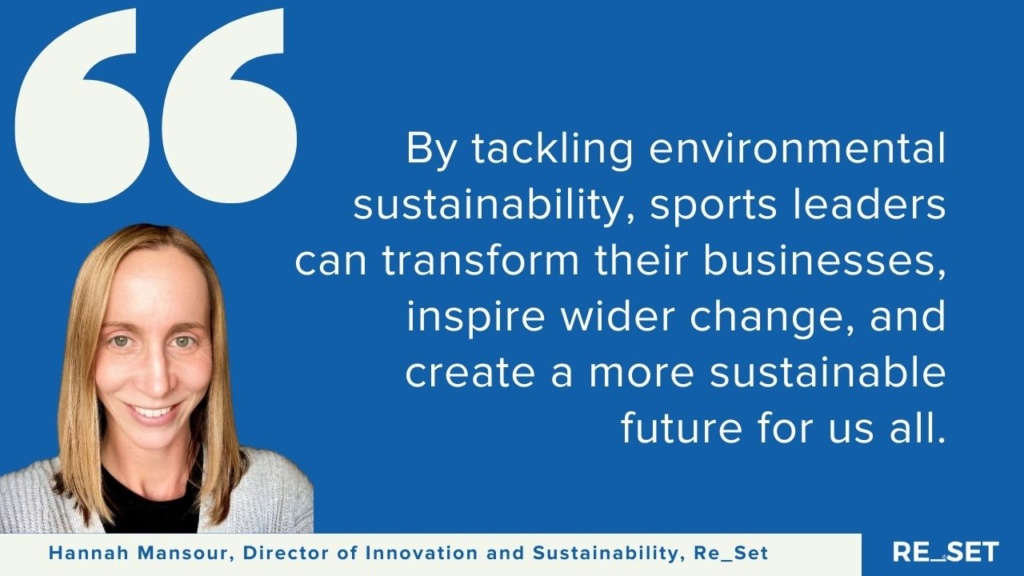
“Investing in sustainability can create new business value through new growth opportunities, increased trust, reduced costs and risk mitigation,” says Hannah Mansour, Director of Innovation and Sustainability at Re_Set. “We have seen clients in other sectors realise significant benefits from putting sustainability at the heart of their strategy and believe the opportunity is there for the sports sector to do the same. By tackling environmental sustainability, sports leaders can transform their businesses, inspire wider change, and create a sustainable future for us all.”
Hannah Mansour is the Director of Innovation and Sustainability at Re_Set. Sophie Coleridge is a Consultant. Want more insights from the Re_Set team? Follow us on LinkedIn, or sign up to our newsletter for our latest thinking.
Want to find out how Re_Set is helping businesses like yours stay competitive in 2022? Get in touch.

