Sustainability may have been a buzzword at this year’s London Fashion Week, but a speedy shift to circularity is required if the industry really wants to change, says Alex Bunting
The fashion industry is one of the most polluting industries on the planet. In fact, its supply chains are so complex and untransparent that, to this day, the extent of its impact on global carbon emissions are still unclear. Estimates range from 4 per cent to 10 per cent. To put that in context, the aviation industry is estimated at 2.5 per cent, making the fashion industry at its worst, four times more polluting.
And let’s not forget that fashion’s impact is not just environmental. Documentaries like The True Cost have highlighted the multitude of social sustainability issues at the hands of the industry. The Rana Plaza disaster in Bangladesh in 2013 had a death toll of over a thousand garment workers and highlighted the modern-day slavery still at play in the industry, particularly among women.
In Kazakhstan, the Aral Sea, which used to be the world’s fourth largest freshwater lake, has dried up in the 50 years since ‘fast fashion’ came to be (and cotton demands have skyrocketed), forcing communities to abandon their homes and livelihoods.
And, just last week, activists at the Pretty Little Thing fashion show protested the paltry salary of its Leicester-based garment workers (only £3.50 an hour), while the Creative Director earns £4.8 million annually. Modern-day slavery remains very much alive and kicking, and at play the whole world over.
Yet while the industry’s negative impact on the planet is vast and has long been recognised, fashion still fails to clean up its act and decarbonise at the rate of other industries. Why?
What is sustainable fashion anyway?
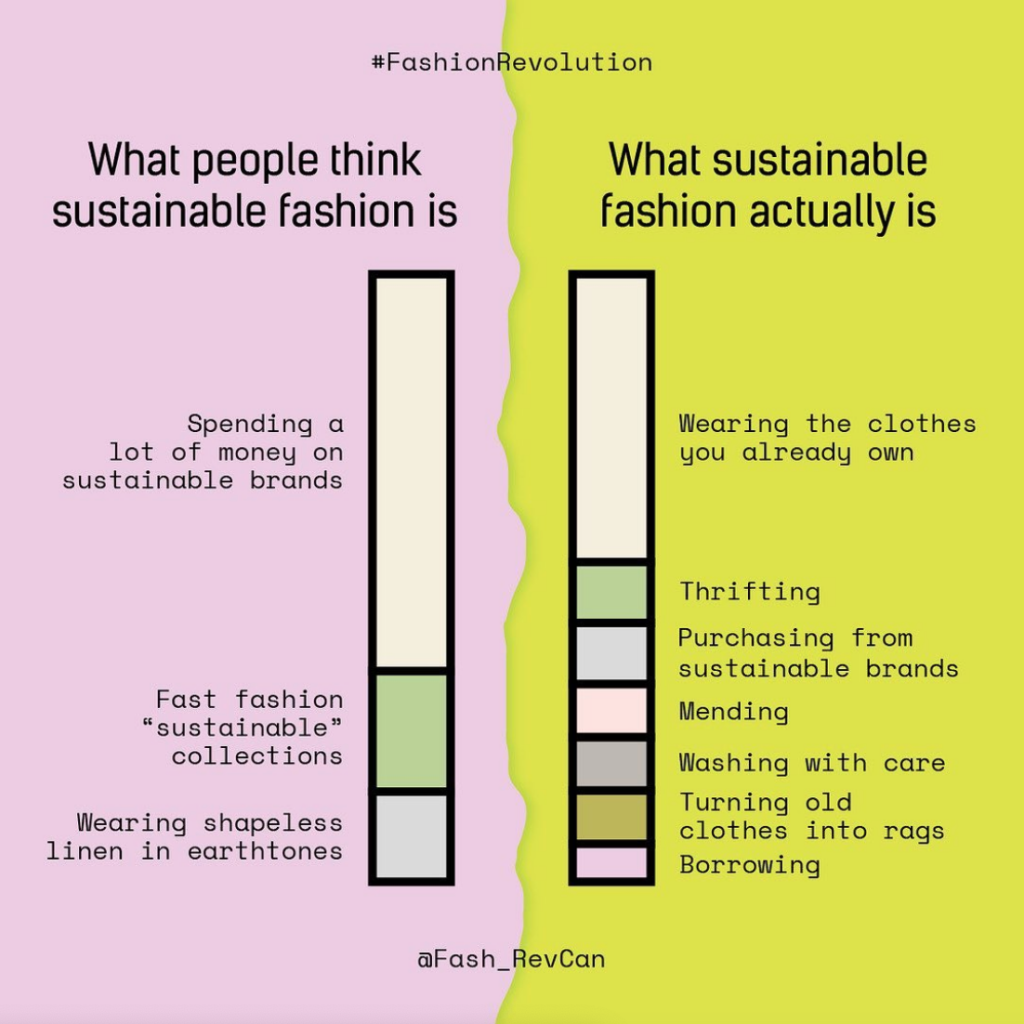
While we are increasingly seeing businesses and consumers trying to engage with ‘sustainable fashion’, we aren’t seeing the results because there’s a fundamental misunderstanding about what ‘sustainable fashion’ actually looks like.
As the non-profit Fashion Revolution highlights, sustainable fashion is not about spending lots of money on sustainable brands or collections – it’s about wearing the clothes already owned more or buying second-hand.
The difficulty for many businesses seems to be that being honest about this is at odds with their overriding ambition: growth at all costs. This obsession with growth in fashion – to sell more clothes to more people more frequently – is particularly palpable and destructive. There’s a reason that Patagonia’s Black Friday advert in The New York Times, is so famous – because it drives right to the heart of the issue of consumerism.
A compelling proposition
So, how can the sector meaningfully engage with sustainability to decarbonise at the rate that is needed? Fashion businesses need to turn their sustainability strategies into action and meaningfully transition from linear to circular and create products that are designed to be: used more, made to be made again, and made from recycled or renewable inputs.
While this may seem challenging in the context of where the industry currently sits, the transition to a circular economy represents a $560 billion economic opportunity for the industry, according to the Ellen MacArthur Foundation, making it a compelling proposition.
But be warned: while circularity currently poses a competitive advantage for fashion businesses on the front foot, it will soon become a necessary state of play. For those that don’t commit to transitioning, be prepared to watch your business get left behind.
If you’re still feeling overwhelmed about how to kickstart this transition, here’s how to begin.
How the fashion industry can transition to circularity
1. Listen to Gen-Z
The truth is, to reduce the industry’s impact on the planet, fashion businesses need to make less, and consumers need to buy less. But this doesn’t have to mean saying goodbye to your business. It just means adopting more circular business practices, which in turn can deliver new commercial opportunity and increase acquisition of the more environmentally conscious Gen-Z. Take the growth of the resale market for example. It is expected to be almost twice as big as fast fashion by 2029, with an estimated value of $80 billion. What’s more, looking at Depop, one of resale’s top players (sold to Etsy last year for an astonishing $1.6 billion), over 90 per cent of its 30 million users are under the age of 26, highlighting just how much Gen-Z are driving the change.
2. Change your success metrics
In Harvard Business Review’s The Myth of Sustainable Fashion, the former COO of Timberland, Kenneth Pucker, summarises his experience as an executive working in the industry: “Never once did a CFO ask me if the business could contract to yield a more durable customer base,” he remembers. “Nor did I ever hear from a Wall Street analyst making a pitch for Timberland to prioritise resilience ahead of revenue growth.”
This unrelenting pursuit of growth causes the fashion industry to focus on how things can be done more cheaply or quickly, because as Kenneth puts it: “It is hard to make a better-performing or more efficient blouse.” And this all adds up to an unsustainable business model, with knock-on effects environmentally and socially.
As such, it would be wise for the fashion industry to look at growth with more of a long-term lens and consider how circular initiatives, like repair and rental, can drive long-term customer loyalty and brand advocacy.
3. Factor value leakage into your balance sheet
The World Economic Forum tell us that the fashion industry has doubled clothing production in the last 15 years, while the duration of time clothing is worn before it is thrown away has fallen by around 40 per cent. Then, once it is thrown away, 73 per cent is burned or buried in landfill. Only 12 per cent gets collected for recycling and less than one per cent of what is collected is used to make new clothing.
This paints a terrifying picture of the industry’s impact and highlights just how much value leakage exists from waste within the industry.
Incorporating your business’ value leakage into your balance sheet will prove a key driver in highlighting to even the most sceptical executives the imperative to adopt a more circular operation – not only in reducing waste, but also on improving your bottom line.
4. Remember: fortune favours the bold
Want to make a real difference? Stop wading in the shallows with never-ending circular trials and pilots. Among industry behemoths, these are becoming increasingly popular – yet the number of trials progressing from pilot stage to BAU in the longer term appear less common.
One obvious blocker would seem to be pilots that are more marketing exercises than commercially driven, circular initiatives. (Did someone say ‘greenwashing’?) Yet, even if they are genuine attempts at sustainability, since these pilots are small scale, they will, by definition, only ever have incremental benefit. Because they aren’t garnering the momentum required to attract the masses or meaningfully reduce emissions, they’re unable to prove the full potential of circularity.
As such, businesses looking to make a genuine positive impact must recognise the limitations of pilot schemes – using them to fail and learn fast, but then quickly move forward to deliver mass market circular propositions. This is the only way to drive serious benefit for customers, your business and ultimately the planet.
Alex Bunting is a Consultant at Re_Set.
Want more insights from the Re_Set team? Follow us on LinkedIn, or sign up to our newsletter for our latest thinking. Want to find out how Re_Set is helping businesses like yours stay competitive in 2022? Get in touch.